


Organisations across every industry are exploring how AI can help employees work more efficiently. Drafting emails, summarising meetings and generating reports are now everyday tasks for AI assistants. But these tools still rely on people to drive each step.
Microsoft’s newly launched Copilot Cowork marks a shift from assistance to autonomous action.
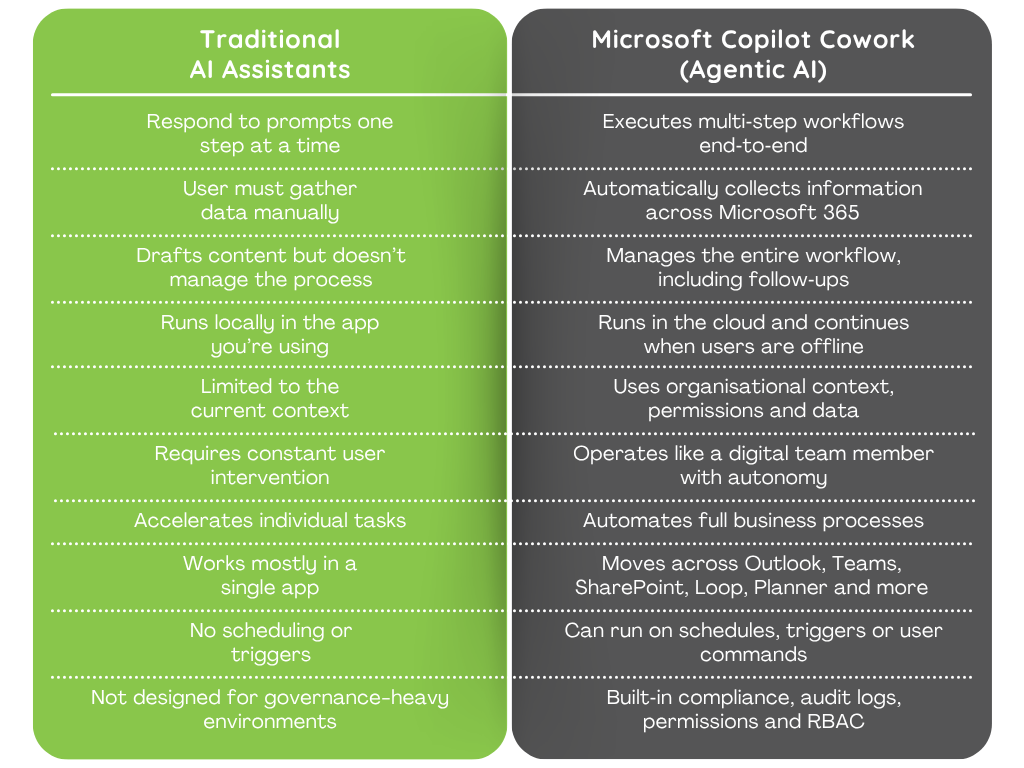
Rather than responding to prompts, Copilot Cowork is an agentic AI capability for Microsoft 365 that can execute multi‑step business workflows with minimal user involvement. It gathers information, moves across applications, prepares outputs, and progresses tasks using the context, data, and permissions already available within your organisation.
Because Cowork runs in the cloud, workflows continue even when users are offline — a fundamental change in how organisations think about productivity.
Instead of helping people complete tasks, AI can now take responsibility for entire business processes.
Traditional AI Assistants vs Microsoft Copilot Cowork
Where organisations will see value
The strongest use cases for Copilot Cowork are the recurring, operational workflows that happen every week, month, or quarter — the ones that don’t require deep expertise but consume considerable time.
Examples include:
- Operational and executive reporting
- Project status updates
- Client briefing packs
- Meeting preparation and follow‑up
- Compliance and governance reporting
- Standardised communications and updates
Traditional AI can draft content, but someone still needs to gather data, check accuracy, format outputs, distribute updates, and manage follow‑up actions.
Cowork behaves more like a digital team member that handles much of this automatically, improving consistency, reducing administrative effort, and accelerating delivery.
The goal isn’t fewer people — it’s enabling skilled employees to spend less time assembling information and more time interpreting it, solving problems, and supporting customers.
For many organisations, this is the first practical step toward automating knowledge work rather than simply speeding up individual tasks.
How Copilot Cowork works in practice
A simple example:
Monthly project update workflow
- Operational and executive reporting
- Project status updates
- Client briefing packs
- Meeting preparation and follow‑up
- Compliance and governance reporting
- Standardised communications and updates
All of this can be triggered by:
- A recurring schedule
- A user command
- A business event (e.g., a file update or meeting)
This is the difference between AI assistance and agentic automation.
How organisations access Copilot Cowork
For organisations already licenced for Microsoft 365 Copilot, Cowork is available through a consumption‑based model using Copilot Credits. This allows usage and cost to scale with workload requirements.
At launch, Cowork includes:
- Integrations with partners such as Miro, Monday.com, Moody’s, and Harvey
- Built‑in security and compliance features including audit logs, eDiscovery, DSPM, and Insider Risk Management
- Support for multiple AI models, including OpenAI and Anthropic
- Cloud execution so tasks continue running when users are offline
- Cost management tools for budgets, alerts, and usage tracking
Implementation: where to start
Successful adoption depends less on technical setup and more on understanding the business processes behind it.
Most organisations already have the foundations in place. The real work lies in identifying where Cowork can create the greatest impact and ensuring the right governance, permissions and information structures exist.
The people who typically drive success are those who understand how information moves through the business:
- IT managers and administrators
- Department leaders
- Process owners
- Governance and compliance teams
Their focus usually includes:
- Identifying suitable workflows for automation
- Reviewing information access and permissions
- Confirming governance and compliance requirements
- Ensuring data quality and reliability
- Defining review and approval steps
The technical setup is often straightforward. The bigger challenge is deciding which processes to delegate first and ensuring the information Cowork relies on is trustworthy.
Most organisations begin with a single workflow — such as a management report or project update — before expanding into more complex scenarios.
Governance and compliance remain critical
Copilot Cowork operates within your existing security, compliance, and permission frameworks. It can only access information its assigned role is authorised to use and remains subject to organisational controls and policies.
For regulated industries, considerations may include:
- Data residency
- Retention and lifecycle policies
- Sensitivity labels and information protection
- Audit and reporting requirements
Strong governance not only supports compliance but also improves the reliability of AI‑generated outcomes.
The role of data quality and why Microsoft Fabric matters
The effectiveness of any AI system is directly tied to the quality of the information available to it.
When data is fragmented, duplicated or poorly governed, AI spends more time resolving inconsistencies and less time delivering meaningful results.
This is where Microsoft Fabric becomes increasingly important.
Fabric unifies organisational data into a governed, consistent environment giving Cowork a more reliable foundation for automation. With better access to trusted information, Cowork can deliver more accurate outputs, faster insights, and greater operational value.
As organisations move from experimentation to enterprise‑wide AI adoption, the relationship between agentic AI and modern data platforms will become essential.
The next stage of AI adoption
Copilot Cowork is more than another productivity feature. It represents a shift in how organisations can apply AI within day‑to‑day operations.
The organisations that see the greatest value will be those that:
- Start with practical, high‑value workflows
- Establish strong governance foundations
- Ensure data quality and information structure
- Focus on solving real operational challenges
If you’re considering how Copilot Cowork could support your business, the first step is identifying which processes would benefit most from automation and ensuring your environment is ready.
At Essential Tech, we help organisations assess their Microsoft environment, identify high‑value use cases, and develop practical AI adoption strategies aligned with business objectives, governance requirements, and existing workflows.
Whether you’re exploring your first AI‑driven workflow or planning a broader automation strategy, our team can help you build a roadmap that delivers measurable outcomes.
Contact Essential Tech for more information
Contact us to plan or review your AI roadmap today.
Next in this series: How Microsoft Fabric Turns Data Into Action: The Missing Link in Your AI Strategy